
Is Your ESG Data Ready for a Bursa Malaysia Audit?

ESG Data Audit Readiness Framework is a guide to help companies prepare for ESG reporting beyond spreadsheets and assist in the process.ESG Data Audit Readiness Framework is a guide to help companies prepare for ESG reporting beyond spreadsheets and assist in the process.
However, in order to avoid the risks of chaos in spreadsheets and ensure a smooth audit ready ESG data management process in Bursa Malaysia, the ESG data has to be managed as a controlled reporting process: with clear ownership, documented methods, evidence attached to every data point, and a system that maintains a complete audit trail. While spreadsheets can provide a first report out of the door, they have trouble when an external assurer requires data lineage, approvals, and change history.
The timeline makes this more of an operational issue rather than a project for the future. Bursa Malaysia is implementing the external assurance of sustainability reports in a phased manner. Under Bursa Malaysia’s Listing Requirements, Main Market and ACE Market issuers must state whether their sustainability statements have been internally reviewed or independently assured. Mandatory external reasonable assurance for Scope 1 and Scope 2 GHG emissions under the NSRF will be phased in for annual reporting periods beginning on or after 1 January 2028 for Group 1, 1 January 2029 for Group 2, and 1 January 2030 for Group 3. That change impacts the level of evidence required for the collection, review and defence of sustainability data.
For official guidance, refer to Bursa Malaysia’s Sustainability Reporting Guide and Toolkits (3rd Edition), where applicable to your reporting period, and the National Sustainability Reporting Framework (NSRF). The phased assurance dates are set out in the Securities Commission Malaysia’s assurance update.
Why Mandatory Assurance Requires a System Decision
There is still a need for a disciplined trail even if there is limited external assurance. Assurers audit the process of number creation, the process of editing and the ability to follow reported metrics back to their source. Often it is at those very points that a spreadsheet based process becomes fragile, particularly when multiple business units start feeding data into it and multiple versions begin to circulate.
When reviewed under the microscope of assurance, three issues tend to come to the fore:
- Change control will be difficult to maintain once changes are made without a clear history of who made the change and why.
- Data lineage is not clear as the route from source document to the reported figure is distributed throughout the tabs, email attachments, and manual consolidations.
- Review and approval evidence is spread across: sign offs are in inboxes; calculations are in separate files.
For large listed companies, the business case for moving to a platform is lower assurance costs and lower compliance risk. The idea is to not have to depend on heroic efforts every year when reporting, but to create a repeatable system that can be tested.

Auditor-friendly control design
Audit readiness isn’t about formatting; it’s about infrastructure. The longer a system can’t maintain a stable history of each metric, the more assurance work is required, the more questions that arise, and the more under pressure the reporting team will be in creating evidence.
An appropriate platform should provide the ability to create an uneditable time stamped audit trail of all changes to the data points, narrative content and approvals, including who made the change, when the change was made, and the prior value. Data lineage is made possible by that audit log: an assurer can go back to a reported number and be able to see how it has changed.
A step-by-step blueprint for listed companies in Kuala Lumpur
1. Assign Owners by Metric
Each data owner should be assigned based on the metric, and not the document.
If more than one site reports a metric, each one must have a named owner to whom its definition, inputs and supporting evidence are accountable. In reality, operational teams usually manage energy and emissions data, HR controls workforce data, procurement can manage supplier data, and sustainability and company secretarial teams are responsible for disclosure governance and report collation.
2. Validate at Entry
Wait for consolidation to validate data results in rework which is difficult to prove. Rather, set units, enforce required data, and encourage explanations for irregular movements when submitting. The goal is to have a well-managed capture process, similar to financial reporting discipline.
3. Attach Evidence to Data
Assurance teams will request support to show where the figure came from and the integrity of the figure. These can be any utility bills, invoices, meter photos, internal system exports, etc., but it’s a matter of consistency. Evidence needs to be added to the specific record and not a shared folder that is labeled ambiguously.
4. Use Multi-Level Approval
Auditors often find that nonfinancial data collection is not subject to a formal review and control process like financial data collection. A structured workflow can help bridge that gap. A preparer submits, a reviewer checks, an approver signs off and every step is documented with date and user information.
5. Lock Reporting Periods
Reporting periods should be locked and revisions handled carefully and openly.
Only changes should be approved once and then they should not happen so quietly. If updates are necessary, go through the same process with the updates so that the history is complete and understandable.
When implemented properly, a good ESG data management software will lower assurance findings by consistently implementing these controls. It is not meant to replace the necessity for judgment or expertise, but it will prevent issues that are easily avoidable like missing approvals, undocumented changes, and lack of evidence that can’t be found during testing.
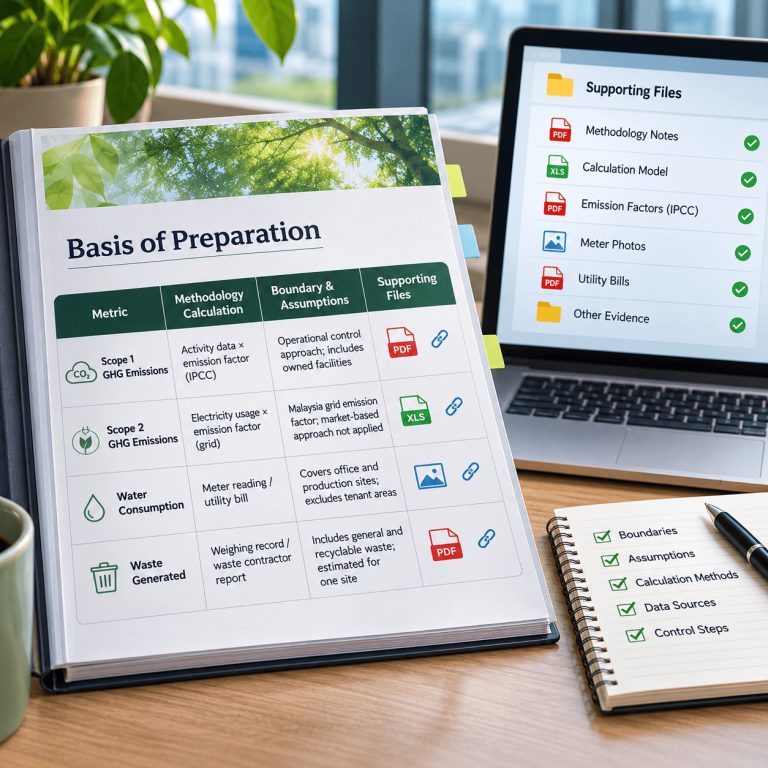
As your defensibility document use the Basis of Preparation document.
Assurance isn’t just about the numbers at the end. Assurers should have knowledge of the definitions and calculations for each metric. A Basis of Preparation document is the actual “bridge” between your disclosures and the methodology used. It usually includes boundaries, assumptions, calculation models, and the controls employed to gather and validate the data.
In spreadsheets, methodologies are often spread out in file notes, past versions and handovers. The risk becomes apparent later when there are inconsistencies from one reporting cycle to another, particularly when staff change or business change structures.
In the case of complex metrics like Scope 3 emissions, the metadata can often be the driver of the assurance conversation. It requires clarity about what is in scope and what is not, as well as understanding of how it uses assumptions or proxies where data is lacking. A defensible position is not improvisation from department to department but rather documentation and use of the approach.
Bringing TCFD aligned disclosures into one operational workflow
Bursa Malaysia has aligned its sustainability reporting requirements with the National Sustainability Reporting Framework (NSRF), adopting the International Sustainability Standards Board (ISSB) standards, IFRS S1 and IFRS S2, which incorporate the earlier Task Force on Climate-related Financial Disclosures (TCFD) recommendations. The disclosures cover governance, strategy and risk management as well as metrics and targets. That combination makes one of the most common failures: writing the narrative in documents, numbers in spreadsheets and approvals via email.
A single platform based workflow can keep qualitative narratives and quantitative metrics connected. That connection matters because governance and strategy statements are often supported by specific indicators and targets. If those pieces are reviewed separately, inconsistencies can slip through and create avoidable assurance questions.
ESG reporting software can support this by tracking edits, comments, and approvals for both narrative and numbers in the same controlled environment, with the audit trail preserved. The benefit is not convenience alone. It is being able to show, with evidence, that the organization had a clear review chain for what it disclosed.
Closing data quality gaps and managing estimation risk
Nonfinancial data processes are often less mature than financial reporting processes, and auditors regularly encounter weak aggregation and review routines across business units. That does not mean you cannot use estimates. It means estimation must be controlled, documented, and repeatable.
To reduce estimation risk during assurance engagements, we recommend building these practices into your operating model:
- Use a documented method for missing data, including which proxies or factors are acceptable internally and when they can be applied.
- Clearly flag calculated versus actual values so reviewers and assurers can focus testing where judgment was used.
- Embed calculation models into controlled processes rather than leaving key logic in personal files that can change without traceability.
- Apply the same approach across departments, and document any approved exceptions so the rationale is visible.
Technology does not fix weak source data on its own. Garbage in, garbage out still applies, so data ownership and operational knowledge remain central even after implementation.
Implementation roadmap and team structure that works in Malaysia
The first practical step beyond spreadsheets is not software procurement. It is creating a metric inventory that lists each required disclosure, the metric owner, the source, the evidence expected, and the approval path. That inventory turns reporting from a set of tasks into a designable control system.
From there, implementation usually works best in stages:
- Stabilize the process by aligning definitions, owners, and a consistent evidence standard.
- Select and configure the platform around assurance requirements, including audit logs, workflow approvals, and the ability to link methodologies to reported data points.
- Establish ongoing governance by appointing data stewards within departments, scheduling reviews, and defining how changes are managed after approvals.
Platform selection should match organizational scale and reporting complexity. Look for the controls that support assurance: uneditable audit trails, configurable approval workflows, evidence attachment, and strong metadata management so the Basis of Preparation stays connected to the metrics.
Resource constraints are real. Implementing dedicated software takes cost, time, and internal training, and it is not plug and play. There is also a shortage of professionals who combine sustainability, data management, and assurance knowledge. Bringing finance and internal audit teams into the governance structure can help, because they already work with controls and evidence standards.
Preparing for assurance while building long term resilience
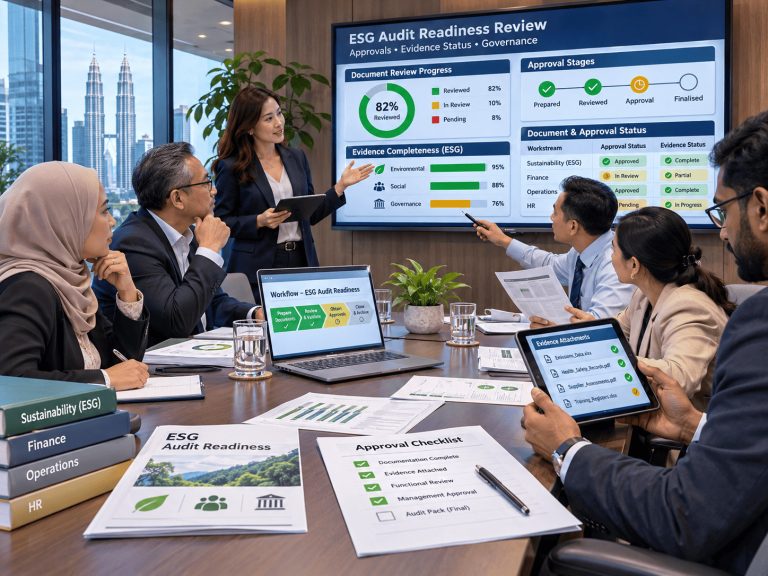
Before an external assurer starts testing, a readiness assessment can reduce surprises. Select a sample of higher risk metrics and run them through a proof exercise: can the team trace each figure to source evidence, show the approval trail, and explain the method using the Basis of Preparation without relying on email searches.
Two cautions should stay on the table. First, do not expect a platform to compensate for unclear definitions or weak ownership. Second, avoid over relying on system configuration without understanding what Bursa Malaysia requires and how the reporting framework connects to your operations. Compliance comes from the combination of process maturity and technology controls.
At TellUS Report, we help organizations design an assurance ready reporting operating model, from governance and workflow design to the practical requirements that make audits smoother over time.
Request an ESG assurance readiness consultation with TellUS Report
Frequently Asked Questions
What is the fastest way to move ESG reporting off spreadsheets for Bursa Malaysia reporting?
Start by building a metric inventory that assigns an owner, defines the source and evidence for each metric, and sets the approval workflow. That inventory becomes the requirements document for any system you choose.
What system capability do auditors care about most for ESG assurance?
A time stamped, uneditable audit log that records every change to data, narratives, and approvals, because it enables data lineage and reduces manual reconstruction during assurance testing.
What should we include in a Basis of Preparation document to support assurance?
Document the boundaries, assumptions, calculation methods, and control steps for each metric, and ensure those methods are directly linked to the data points, especially for complex areas such as Scope 3 emissions.
How should we handle missing ESG data and proxy calculations during an assurance engagement?
Use a documented methodology that is applied consistently, clearly label estimated or calculated values, and keep the supporting logic and evidence attached so the approach is transparent during review.
Where can we contact TellUS Report about ESG data audit readiness in Kuala Lumpur?
Visit https://tellusreport.com to reach our team and discuss your assurance timeline, reporting workflows, and the controls needed for audit ready sustainability reporting.