ESG Software Strategy for Malaysian Enterprises: Choosing Between Data Management and Reporting

ESG data management software collects, validates, and preserves auditable ESG data from sources like utility systems, IoT sensors, HR systems, and supplier inputs, while ESG reporting software turns validated data into disclosures aligned to Bursa Malaysia and frameworks such as GRI and IFRS S1 and S2. Most Malaysian organizations end up needing both, because strong reporting depends on controlled data that can stand up to regulator and investor scrutiny.
For most teams in Malaysia, the hardest part isn’t the final report format. It’s the data history behind every number. Spreadsheet based workflows become difficult to deliver consistent tracking, evidence and readiness to assurance in relation to time series as Bursa Malaysia enhances the disclosure expectations in relation to climate change following the recommendations of the TCFD. The following is the way we’ve been helping enterprises to split the two software levels, select an architecture that will handle the operational complexity, and prevent costly tool changes later on.
The basic difference is between a disclosure layer and a data layer
The workstreams typically become two in an ESG program: what looks like two similar workstreams on a slide deck, but is vastly different in reality.
The first is the creation of data and data control. Data management tools are designed to facilitate the automation of ingestion and consolidation of data on granular ESG inputs, such as utility bills, sensor data, HR data, and supplier surveys, and then perform checks and governance to ensure that the data stored is defendable later. The objective is to have one source of truth that is auditable.
The second is production of disclosure. Reporting tools are designed to emphasize workflow, collaboration and mapping validated metrics to the framework structure demanded by multiple frameworks. They are intended to control the narrative, cross references, approvals and output formatting and rely on clean upstream data. When the data is poor, the report is a pretty presentation of numbers that are not sure. The classic garbage in, garbage out problem mentioned in the research occurs.
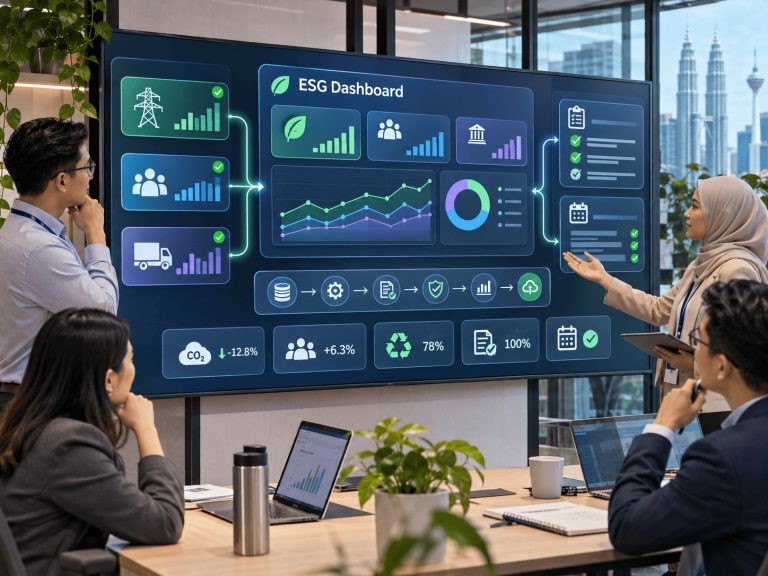
Inefficient data management is becoming a problem. Data management is no longer an option, it is a problem for Bursa Malaysia reporting on the climate.
Bursa Malaysia’s sustainability reporting requirements for Main Market listed issuers have been updated to align with the National Sustainability Reporting Framework (NSRF), incorporating the ISSB standards, IFRS S1 and IFRS S2, including climate-related disclosures. In practice, this means that organisations need to monitor their climate performance indicators (e.g. GHGs, energy consumption) over time. That time series requirement changes software conversation.
Analysis can be facilitated with the use of spreadsheets, but they do not necessarily provide a strong audit trail across numerous sites, frequent changes, and multiple contributors. As the reporting cycles continue and teams change, version control risk, manual consolidation and lack of evidence become more likely. Assurance readiness is when investors expect it; the question then becomes easy: can we demonstrate how a number was generated, who handled it and what it was based on?
For reference, Bursa Malaysia’s announcement is here: Bursa Malaysia enhances sustainability reporting requirements for Main Market listed issuers.
A comparison of data platforms and report generators to be used to make decisions.
Comparing vendors becomes more straightforward if you try every tool with the job that it needs to perform. Apply the following criteria to determine if you are reviewing a data foundation, a disclosure engine or a combined platform designed to do both.
| Decision Criteria | Data Aggregation and Management Platform | Report and Disclosure Generation Tool |
|---|---|---|
| Data collection | Automates ingestion from sources like utility invoices, IoT sensors, HR systems, supplier surveys and more. | Usually requires confirmed input, and may ask for input but does not substitute for source level input controls. |
| Validation | Designed for completeness check, workflow validation and controlled updates. | Engages in review and approval of the report package, uses upstream validation quality. |
| Hierarchy management | Helps with site and business unit structures and consolidation logic for a variety of operations. | Typically sets up the sections for a report well, may not execute operational consolidation in great detail. |
| Dashboards and tracking | Monitors performance indicators and calculates them repeatedly over time for internal monitoring. | Monitors and closes out reporting activities, with less focus on operational monitoring. |
| Framework mapping (GRI, IFRS S1 & S2, Bursa Malaysia, TCFD) |
Will retain tagged metrics but is not necessarily optimised for disclosure narratives and framework cross-referencing. | Maps validated metrics to framework-aligned disclosures and controls multi-framework outputs. |
| Integrations | Needs strong connectors and APIs to operational systems and supplier data channels. | Typically connects to the data layer, document workflow and collaboration applications. |
| Audit trail | Preserves the lineage of each data point from the source to the final number at an investor-grade level. | May provide end values and approvals, but may not have a robust data layer to provide source lineage. |
This table also helps to dispel a common misconception: a reporting tool cannot generate missing Scope 1 or Scope 2 activity data. Can only show what you give. When the business is moving towards a more granular disclosure of climate data, it is likely to be the business that is the longer-term constraint.
Making the right architectural decision without committing to the wrong cost base
Software strategy = Architecture strategy. Switching to a new platform becomes extremely costly as soon as it becomes your system of record, particularly if you have developed integrations and internal processes around it. The research shows a real balancing act between combined platforms and best of breed, and the objective is not to choose the trendy model. It’s a question of choosing the right model for your work.
Common architecture options
- Standalone reporting engine: A good choice for large groups with complex sites and multiple data sources. The data layer is responsible for ingestion, validation, hierarchy and traceability. The reporting layer is based on disclosures and framework mapping.
- All in one platform: Functions if the entire solution is truly effective both at the data collection and reporting end. The problem is that some of the integrated tools are more capable of reporting than ingesting operational or IoT data and can lead to workarounds.
- Best of breed integration: A conscious approach that combines a robust data engine with a flexible data reporting front end. This can work for diversified Malaysian conglomerates with plantations, manufacturing, logistics and corporate operations, provided there is a reliable API integration and governance.
The common mistakes that people make when buying the wrong tool that we see during selection
- Starting with reporting, then realizing that a controlled data layer is necessary to generate auditable Scope 1 & Scope 2 metrics, teams resort to spreadsheets for consolidations.
- When all in one means end to end capability, then the ingestion layer cannot be used in a stable manner to ingest operational data sources, which means a second procurement cycle.
- Choosing separate tools without integration planning, which results in file exports and manual re entry that bring back human error and version control risk.

Assurance readiness depends on audit trails, not good intentions
As scrutiny on greenwashing increases, many stakeholders expect that ESG numbers can be verified. Research emphasizes that data management platforms provide a detailed audit trail for every data point, tracing from origin through transformation to the final reported figure. That lineage is what third party assurance providers use to test integrity.
When we evaluate a data management platform with clients, we focus less on how the dashboard looks and more on how evidence survives the reporting cycle. Useful capabilities include clear source attribution, documented validation steps, and approval history connected to each metric, not only to the final report file. A platform that cannot show data lineage forces teams to rebuild evidence manually during assurance, which often becomes a costly distraction close to disclosure deadlines.
Scope 3 and supplier data collection: plan for friction, then automate it
Scope 3 is where most organizations feel the gap between what frameworks ask for and what suppliers can deliver quickly. Supplier data can arrive late, in inconsistent formats, and without clear documentation. A robust data layer is designed to ingest supplier survey inputs alongside internal systems, then track what was requested, what was received, and what still needs validation.
Operational diversity adds another challenge for Malaysian enterprises. A group with plantations, manufacturing sites, and logistics operations will not have one uniform dataset or reporting cadence. A data management layer helps synchronize these sources into consistent structures, while the reporting layer maps the validated outputs to Bursa Malaysia expectations and global frameworks for international investors.

Implementation and integration: avoid manual handoffs that recreate spreadsheet risk
Tool selection is only half the decision. The rest is how data moves through the organization. The research warns that poor integration can recreate data silos and push teams back into manual transfers, which defeats the purpose of adopting ESG software.
Before configuration begins, we recommend locking down three practical deliverables:
- Data source inventory: a list of the operational systems and supplier channels that will feed ESG metrics, including ownership for each data stream.
- API integration protocol: rules for how the data layer syncs with the reporting layer, with clear change control so calculations do not drift between cycles.
- Internal workflow design: who submits data, who validates it, who approves it, and what evidence must be attached so assurance work is not done twice.
At TellUS Report, we support organizations by turning these requirements into a practical software decision and implementation plan that fits Bursa Malaysia reporting expectations and the realities of large scale operations. Learn more about our approach at TellUS Report.
Conclusion
In Malaysian ESG programs, reporting pressure often shows up first, but the durable advantage comes from controlled, auditable data. A reporting tool helps you assemble and map disclosures across frameworks, but it cannot compensate for missing evidence, weak validation, or inconsistent consolidation across sites and suppliers. The cleanest decision is to separate the data layer from the disclosure layer, then choose an architecture that can scale as Scope 1, Scope 2, and Scope 3 complexity grows. If you want a structured way to compare options and reduce spreadsheet dependency without creating new integration risk, we can help you run a focused decision workshop.
Request an ESG software decision workshop with TellUS Report
Frequently Asked Questions
Do Malaysian Main Market listed companies need both ESG data management and ESG reporting tools?
Many do, because Bursa Malaysia’s ISSB-aligned sustainability reporting requirements under the NSRF call for consistent time series tracking and verifiable metrics, which typically depends on a strong data foundation, then a reporting layer to map validated numbers into compliant disclosures.
Can we buy ESG reporting software first and add data management later?
You can, but the risk is that the reporting tool ends up relying on uncontrolled spreadsheets, which weakens audit trail and assurance readiness. For climate indicators that must be tracked over time, a dedicated data layer often becomes the priority.
How does ESG data management software help with Scope 3 supplier data in Malaysia?
It is designed to ingest supplier inputs such as surveys alongside internal operational data, then apply validation and tracking so your team can manage follow ups, reduce manual consolidation, and preserve evidence for future reporting cycles.
What should we check to confirm our ESG data is ready for third party assurance?
Focus on investor grade data lineage for each metric, including source attribution, validation history, and approval records. Assurance providers need to trace figures from the source through to the final reported number.
How can TellUS Report help us choose an ESG software architecture that fits Bursa Malaysia reporting?
We help you define requirements across data collection, validation, hierarchy management, integrations, and framework mapping, then translate them into a selection and rollout plan you can operationalize across business units. Start at TellUS Report.